
Opinion: Creating Equitable Communities

Date Posted: August 6, 2019
Posted In: Discussion,
From St. Louis Post-Dispatch: by Chip Crawford, chair of the Urban Land Institute-St. Louis District Council and managing director at Lamar Johnson Collaborative
Urban planning can be a bit of a mystery, but especially in disenfranchised communities. That is changing in the Ferguson-Florissant School District where the Urban Land Institute St. Louis is teaching students how land use decisions impact their communities. It’s called UrbanPlan.
Now approaching its third year, UrbanPlan has engaged more than 100 students in hands-on urban planning projects, empowering them to have a voice in how development takes place. UrbanPlan is part of the Urban Land Institute’s Equitable Communities Initiative launched in response to three calls to action by the Ferguson Commission including prioritizing transit-oriented development, building healthy affordable housing and stabilizing middle-market neighborhoods. The institute is uniquely suited to address these issues with a membership comprised of urban planners, financiers, architects, real estate developers, legal and accounting professionals, and builders.
The UrbanPlan curriculum teaches students about the trade-offs, economics and other issues that shape realistic land use solutions to vexing urban growth challenges. More than 40 volunteers are trained to facilitate small group discussions among students as they work in teams to develop a responsible land-use project. The curriculum culminates in a presentation of a development proposal by each student team to a “City Council” comprised of Urban Land Institute volunteers.
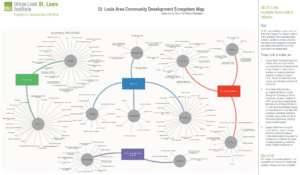
ULI’s St. Louis Community Development Ecosystem Map
“ULI is charting a much-needed pathway for a more diverse generation of urban planners and real estate professionals,” said Dr. Sarah L. Coffin, associate professor and urban plan and development program director at Saint Louis University. “More importantly it is empowering those in our underserved and often forgotten neighborhoods to engage in and guide more socially responsible land use decisions to energize their communities.” The effort to broaden diversity in real estate development will be further energized with ULI’s Real Estate Diversity Initiative (REDI) this fall to advance the careers of women and minority professionals.