
Unifiying Worlds, One Conversation at a Time

Date Posted: August 21, 2014
Posted In: Ideas, News,
by Tom Finan, Executive Director, Construction Forum STL
From the fourth through the seventh grades I lived at 229 Tiffin Ave. in Ferguson, MO. The house (shown here on Google street view) was in the old downtown section of Ferguson, two blocks from South Florissant Road. We used to sled, bike, and play soldiers on a wooded hillside that sloped into the parking lot shared by Kroger, Ben Franklin and the Savoy movie theater, which all faced South Florissant. Today Kroger is gone, Ben Franklin is a a hardware store, and the Savoy is an event venue.
That was a long time ago and a world away,
That time stands out as one of the happiest of my life. In recent years I was really proud of the way in which people in Ferguson were reinvigorating their (“my”) city and building a sense of community. So recent events have made me profoundly sad. But these same events have people of all races and ethnicities in our region talking to one another, and that’s good.
Construction Forum STL was established to “knock down the walls to build a room big enough for everyone.” On Sept. 9th we are hosting an event at the Moto Museum that epitomizes that mission. “Boots on the Ground: What Will it Take?” will be a networking and panel discussion. To register, go to http://events.constantcontact.com/register/event?llr=yhtlezqab&oeidk=a07e9p4tym2c2756a43
Presenters will be Scott Wilson, CEO of S.M. Wilson Co.; John Gaal, EdD, director of training and workforce development at the Carpenters’ District Council of Greater St. Louis and Vicinity; and Greg Mohler, BJC HealthCare vice president, Planning, Design & Construction. Moderating the panel will be Byron Witherspoon, managing executive, supplier diversity for power generation at Ameren. Byron is also a member of the board of advisors of Construction Forum STL. Click here for more information and to register.
Knocking Down Walls
The Sunday after Michael Brown was killed my wife, who is an assistant professor teaching community nursing for BJC Goldfarb, was helping to lead a health fair at O’Fallon Park Recreation complex, near where my Dad grew up. Over 1,000 people, mostly families with young kids, attended. It was encouraging to see the 65 student nurses interacting with the people from the community and getting their eyes opened to what it was like to truly connect with people who came from backgrounds different from their own. During the health fair, city firefighters had to take off for Ferguson. I also had to leave briefly to grab a computer file from our loft at 40/64 and Hampton and get it printed as a poster on Brentwood near the Galleria.
As I headed south on Grand Ave. I passed St. Alphonsus “Rock” Church, where I was baptized 62 years ago, and Delmar, where I lived the first year of my life. As I headed south and then west toward Brentwood, I drove through “walls” of income levels and opportunity. It was very easy to understand the frustration and anger that has grown through the years. And it made me wonder what it will take to knock down those walls once and for all.
Beginning a Conversation
As I stated earlier, the events following Michael Brown’s killing have promoted a lot of discussions.
Last Friday I met Ron Unterreiner, vice president of Ferguson-based Rhodey Construction and founder of the PEOPLE for breakfast in Clayton. Ron had sent me an email that included an essay he had written that began:
“I am sitting here at my ‘Ferguson’ desk pondering the news of the day, national news at that, and thinking about a young, full of fun and life, seemingly happy kid who will not have the same opportunities that you and I have to impact diversity in construction and ultimately improve lives of minorities and longer term, improve whole communities—communities such as Ferguson, Berkeley, Pine Lawn, Beverly Hills, Pagedale and so many others.”
Ron founded PEOPLE with the vision of bringing MBE contractors and established contractors together as people, not companies, in informal settings. As Ron has said repeatedly since starting PEOPLE, he has no other “agenda” than creating opportunities for people of all races to get together to better understand one another on a personal level and possibly develop business alliances.
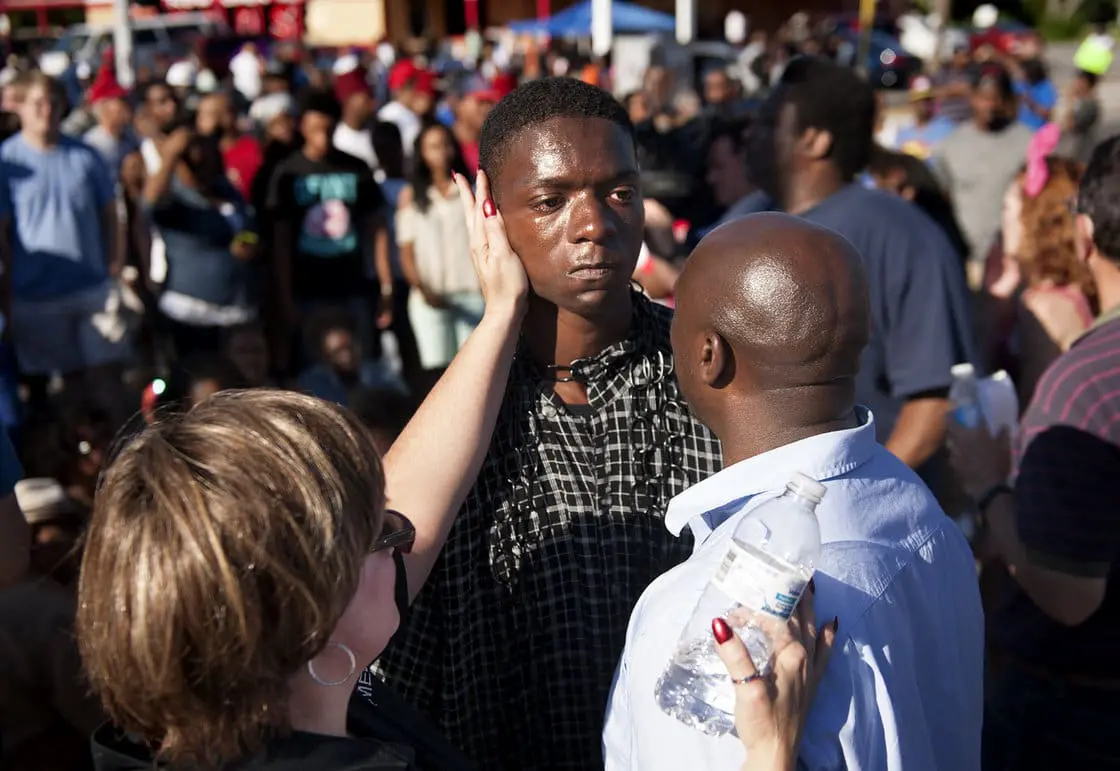 On Sunday, my pastor Matt Miofsky of The Gathering United Methodist Church, told of an invite he had received from his friend Willis Johnson, a Methodist pastor in Ferguson. Willis asked Matt to come up and see for himself. Rev. Johnson appeared in a photo in the Washington Post as he convinced a young protestor to leave the police lines. He was later interviewed on NPR, who he told, “This is not a race issue, this is a human issue.”
Matt, at the request of church leaders, ended up walking in one of the marches along side a young African American man named Calvin. Calvin, who appeared in blue aviator shades and a sideways ball cap in the selfie Matt took of them, quizzed Matt about his reasons for walking, talked with him along the route, then told him at the end of the march, “There needs to be more of this.” Matt wasn’t sure he understood… More protest marches?
“No man, more of you and me just talking to one another.”
That same Sunday, one of our industry’s most successful specialty contractors heard his pastor make a confession. The pastor said that when he was assigned to a church in Ferguson he had focused his attention on the two-thirds who were Hispanic and ignored the African Americans. He wondered how much difference he might have made for that part of his congregation.
At Wednesday night’s meeting of the Midwest Council ASA that same contractor told me his pastor’s conviction convicted him to look at racism in his own company. He is scheduling meetings with his African American, Hispanic and Croatian workers. He is looking at possibilities for creating jobs from the nearby community.
At the same meeting, Scott Negwer, who still lives in Ferguson and whose family business, Negwer Materials, has been there since 1924 told us how he makes a point of going both to the protest area to talk to protestors and residents there, and to the restaurants in the old section of town who are impacted by losing business from Express Scripts employees who are afraid to come into town. Asked how he intended to impact things he said, “When I have meetings, I’m inviting people to come meet me in Ferguson instead of Clayton.” Negwer said that he had stopped doing so before because the restaurants in Ferguson were so bustling. But now seemed like a really good time to him to reintroduce folks to his city.
Come Join Us
An article in Sunday’s New York Times outlined the history of restrictive covenants, block busting, and white flight in the St. Louis area. But, the article said, St. Louis had never experienced quantum change because in the ‘70s when other places were rioting, concessions were made. As painful as recent events have been, if this tumult serves as a catalyst to begin more and more one-on-one conversations and promote real social and political change, that’s a good thing.
Come join us at the Moto Museum on Sept. 9 for “Boots on the Ground: What Will It Take?.
Bringing worlds together starts with a conversation.