
WHITE PAPER: Three Things Better Together Got Right
Regionalism Drill Down White Paper #11
by David Rusk
Special to ConstructForSTL
When Construction Forum St. Louis asked me to undertake an objective critique of the St. Louis City-County Governance Task Force Report to the Community (January 2019) just issued by Better Together, the more closely I examined its recommendations and their justification, the more critical I became. The result was a series of 10 articles published online by the Forum.
But during my first quick read-through of the 141 page document, I was impressed by a number of the Task Force’s observations, saying, as I read “Well, they sure got that right.”
So let me end this series by revisiting three of those issues BT got right, drawing upon my own experience as a mayor and having consulted in over 130 metro areas over the past 28 years.
“The small size of some municipalities, paired with declining and stagnant property tax revenue, made it nearly impossible for many communities to access capital debt markets. The result is an inability to adequately fund necessary infrastructure improvements in communities that most need the investment.”
— Task Force Report, p. 6
“No-debt municipalities largely fell in one of two categories. Some were relatively affluent communities where debt was not utilized because other resources were available to pay for infrastructure investments. The other category included a concentration of small municipalities in north St. Louis County that have been disproportionately impacted by the economic downturn and whose property values never fully recovered after the recession. This led to a reduced ability to rely on traditional funding sources like property tax revenue and ultimately an inability to access debt capital [i.e. sell municipal bonds] through traditional markets.”
— Better Together: The Will To Change (June 2016), p.10
In preparing for my December 6, 2017 presentation to the Forum, I had checked on current bond ratings of St. Louis City, St. Louis County and all its municipalities. Table 1 confirms Better Together’s observations.
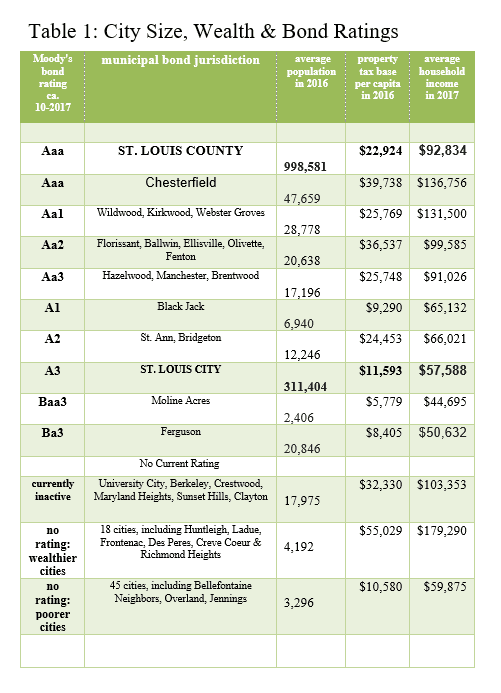
The first thing to notice is that only 16 of the 86 municipalities in St. Louis County had current bond ratings with Moody’s Investors Service as of October, 2017. (Of course, some others may have had ratings from Standard & Poor’s or Fitch’s.) To those should be added the six cities in the “currently inactive” category.
Thus, per Moody’s, three-quarters of county municipalities were not active in the municipal bond market. For 18 cities that may have been by choice; they, including Huntleigh, Ladue, Frontenac, Des Peres, Creve Coeur, and Richmond Heights, were wealthy (average household income: $179,290) with high property tax bases (average property tax base per resident: $55,029). Many had high sales tax revenues as well. They could pay for capital improvement projects out of current income.
But 45 cities fell into the category of low household incomes (average: $59,875) and low property tax base per resident (average: $10,580). Though I have cited the three most populous cities (Bellefontaine Neighbors, Overland, and Jennings), most were very small; two dozen had less than 2,000 residents.
Second, bond ratings followed a progression downward as household income and property tax per resident declined. Household income had a much more powerful impact on the ratings than did property tax per resident – quite possibility because many local General Obligation bonds (i.e. backed by a city’s “Full Faith and Credit”) are based on sales taxes.
Third, only two jurisdictions sported blue-chip Aaa: St. Louis County, the area’s only “Big Box,” and Chesterfield, the newest community in West County. Eleven cities had excellent to good bond ratings (Aa1 to Aa3), but, while A1 may be an excellent steak sauce, it indicated a mediocre bond rating (A1 to A3). Moline Acres (Baa3) had a bad bond rating while Ferguson (Ba3) was one tiny step above “junk” bond level at which many institutional investors are legally prohibited from buying their bonds.
The challenge is two-fold. In light of St. Louis County’s blue-chip Aaa rating, how might that be leveraged a) to lower the costs of borrowing by lesser credit-worthy cities, and b) to open up access to bond markets to cities that are too small or too poor to afford to do so on their own?
“[P]roliferating municipalities [are] also marred by implicit and explicit federal and local public policies that perpetuated and promoted racial segregation, adding to the depth and magnitude of governmental fragmentation, racial disparities, and inequity… [It is difficult to deny that race and racism had a role in perpetuating fragmentation in our region.
—Task Force report, pp. 3 & 4
Many factors influence the degree of residential segregation in our metro areas, but “little boxes” fragmentation has a strong impact. To match up with the St. Louis MO-IL metro area (2.8 million residents; 18% Black), I examined 41 other metro areas of at least 1 million residents and whose regional population is between 10% and 30% Black.
There was a solid correlation (0.43) between a common index of Black/White segregation (100 = total apartheid) and the degree of governmental fragmentation as measured by Dr. David Miller’s Metropolitan Power Diffusion Index, or MPDI (the higher the number, the greater the fragmentation).
Table 2 matches up ranks baker’s dozens of the most and of the least racially segregated metro areas from this group. (A baker’s dozen captures Indianapolis, Louisville and Nashville – three consolidated city-counties often cited as examples by Better Together.)
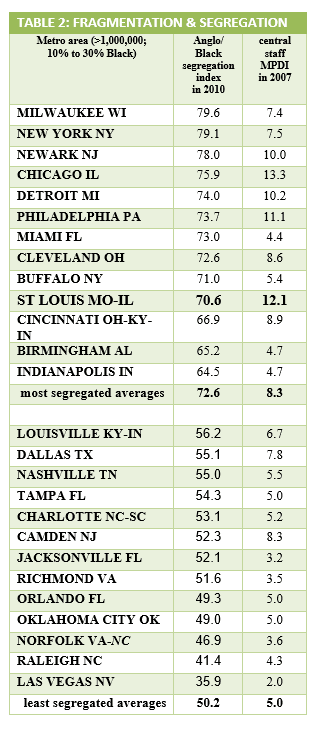
The comparison suggests other factors as well. For the most part the less segregated metro areas are younger “Big Box” regions, located in the Sunbelt, and growing rapidly; most more segregated metro areas are older “little boxes” regions, located in the Rustbelt, and growing more slowly. Many of their central cities continue to lose population (nose count) and, more importantly, households (residential taxpayers).
Segregation indices are calculated on the basis of census tracts without regard to governmental jurisdictions. Why should local governance structure matter?
In my experience “Big Box” mayors, councilmembers, and county commissioners tend to have broader, more racially and economically diverse constituencies; they oversee a larger geography within which to enact more egalitarian housing and zoning policies if they choose to do so.
By contrast, the world surrounding “little boxes” mayors and council members is very constricted and highly sorted by race and class. Many see their mission as “to keep our town just the way it is for people just like us – whoever “us” happens to be. Even a “little boxes” politician with a more inclusive vision has a very limited canvass on which to paint.
So, governmental fragmentation facilitates racial and economic segregation.
“[What happens when otherwise intertwined metropolitan areas slice themselves up into tiny pieces [?] Fragmented government, in short, makes entire metros horribly inefficient. It hamstrings their ability to solve collective challenges. And it costs them economically, too.”
—Organization for Economic Co-operation and Development, quoted approvingly in Task Force report, p.4
The most compelling study I have seen of the relationship between governmental fragmentation and economic growth is by Dr. Jerry Paytas (“Does Governance Matter? The Dynamics of Metropolitan Governance and Competitiveness”). Paytas examined trends in governance and economic growth in 285 metro areas from 972 to 1997, using Miller’s MPDI to measure fragmentation and a measure of economic competitiveness derived from a dynamic shift share technique.
After extensive and sophisticated statistical analysis Paytas concluded that the findings indicate that
Controlling for national trends and industrial composition, metropolitan competitiveness is adversely affected by metropolitan fragmentation.… The impact on the smallest metropolitan areas is most severe…. Smaller areas with fragmented metropolitan governance may lack the scope and power to affect the challenges they face. The large negative impact of fragmentation indicates that unity could help resolve the kinds of cross-jurisdictional challenges that are needed for a region to be competitive. These challenges include transportation and infrastructure as well as workforce and social issues (pp 15 & 20)
“[F]ew fragmented regions are likely to be strong competitors, and that they are unlikely to sustain competitiveness over the long-term. Long-term competitiveness requires flexibility, and fragmented regions are less likely to mobilize the consensus for change. Fragmented regions divide the regional constituency, offering opponents of change more opportunities, forums, and even institutional support to resist change. Unification encourages serving the regional constituency rather than parochial interests (pp.22-23).”
Why? Because “little boxes” regions suffer
- cutthroat inter-municipal rivalry over commercial/industrial firms (a primary concern of Better Together)
- unnecessary duplication of services (actually, at fairly minimal cost)
- uncontrolled peripheral sprawl/core community abandonment
- high cost of new infrastructure in peripheral communities
- waste of existing infrastructure in core communities
- hoarding by “winners” of revenues from new investments
- inability to access unified tax base (recall that St. Louis County is one of the region’s few “Big Boxes”); and
- greater economic/racial division = segregation of opportunity (also highlighted by Better Together)
The St. Louis MO-IL region’s high fragmentation index is based on governmental fragmentation in all 15 constituent counties in two states. Overcoming many of these problems will require policies and programs that extend far beyond the boundaries of St. Louis City and St. Louis County.
Previous David Rusk Regionalism Drill Down White Papers in This Series
#1 St Louis City and St Louis County – The Fake Region
#2 The Incredible, Shrinking “Metropolitan City of St. Louis”
#3 Scenic Overlook: Beware the O’Hara Rule
#5 Better Together and Indianapolis: Comparing Fruit Salads
#6 Why Are Some Police and Fire Departments “Better”?
#7 St. Louis County’s Doomed Cities
#8 Was The BT Plan A Recipe for Financial Feast or Famine?
#9 Plan Big, Zone Small; A Regional Approach to STL’s Future
David Rusk is a former mayor of Albuquerque, New Mexico legislator, and federal official who has consulted on regional issues in over 130 metropolitan areas in the USA as well as in Canada, Germany, England, South Africa and The Netherlands
He is author of Cities without Suburbs (4th edition 2012), called “the bible of the regionalism movement,” and three other books.
Mr. Rusk began analyzing the Better Together report for ConstructForSTL as soon as it was issued. In this series of white papers he is drilling down into items ranging from savings from consolidation, to size and ranking of the “statistical city”, economic development, planning and zoning, bond ratings, taxation, political representation, and Metropolitan Council composition.