
McCarthy’s Buescher: St. Louis Building Boom Offers Opportunity for Collaborative Approaches

Date Posted: October 11, 2019
Posted In: Discussion, Ideas, Organizations, Projects,
From the dramatic transformation taking place on Washington University’s Danforth Campus to the world-class St. Louis Aquarium at Union Station that will begin welcoming visitors later this year, the Gateway City continues to enhance its assets and create unique attractions that distinguish the region.
During this era of unprecedented expansion, design and construction firms are increasingly challenged to mobilize their resources to bring these structures to life as quickly and efficiently as possible.
“Collaborative delivery methods can help address two of the construction industry’s greatest challenges: the skilled labor shortage and our clients’ desire for buildings to be delivered faster,” says Mike Stapf, vice president, design integration at McCarthy Building Companies. “Innovative approaches like design-build often drive innovations that lead to more efficient buildings.”
Unlike the traditional method of completing projects through individual contracts with an architect and a builder, design-build combines design and construction services as a single entity. The goal is to harness the expertise of all team members to maximize efficiency, reduce waste and optimize results through all phases of a building project.
 For some building owners, progressive design-build is an increasingly popular option. “What’s unique about the progressive design-build approach is selection of the team before the price is set, allowing the owner to engage the design-build team early on and progress toward a design and contract price together,” says Lisa Washington, executive director/CEO at the Design-Build Institute of America (DBIA). “It can deliver impressive project results when teams follow best practices.”
Benefits to complex facilities
Progressive design-build is gaining momentum across the U.S. as building owners discover its benefits for complex facilities, particularly healthcare and research buildings.
“The advantage of a two-step progressive design-build process is that the owner has a much higher level of assurance that they’re getting what they pay for,” says Mike Felton, principal at CannonDesign, a St. Louis-based architecture firm with specialized healthcare expertise. “Early in the process, the entire team is at the table to define the scope and work toward common goals. What’s good for the outcome of the building is good for everyone involved.”
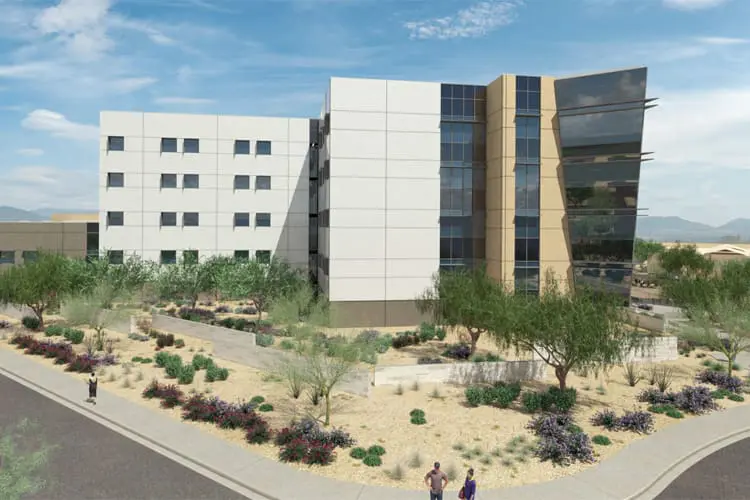 McCarthy is overseeing a major expansion in Phoenix for Dignity Health Chandler Regional Medical Center using the progressive design-build approach. The project includes the construction of a new five-story tower and parking garage as well as renovation of the existing hospital.
“Progressive design-build makes a lot of sense because our healthcare projects rely on input from a large group of users and other project stakeholders,” says Joe Yeargan, director of integrated design delivery in McCarthy’s Southwest Region. “Because it’s a highly collaborative process, you get active involvement from individuals throughout the design phase and simultaneously understand the budget and schedule implications of what’s being discussed.”
Early team collaboration also cultivates innovative design and construction strategies such as the prefabrication of building components to enhance quality, efficiency and safety while streamlining labor requirements. At the same time, progressive design-build helps with resource planning efforts by lining up industry trade partners far in advance. “It helps the construction manager reserve labor to ensure the project is staffed with the best available resources,” says Yeargan.
Building the bottom line
When you have a design team and construction team working together from the beginning of a project, speed-to-market is a bottom-line benefit, according to Stapf. “Both the architect and builder are committed to the same goals and motivated to work together to achieve the best possible outcomes,” he says.
And the evidence bears this out. According to a 2018 study conducted by the Construction Industry Institute and Charles Pankow Foundation, the design-build delivery method outperforms traditional construction approaches in terms of cost, schedule, reliability and other measures. By 2021, design-build is projected to account for 44 percent of total construction spending.
Another collaborative delivery method — integrated project delivery (IPD) — brings together the owner, construction manager and architect under a single shared risk-reward contract. The Oregon Health & Science University (OHSU) Knight Cancer Research Institute used IPD on its new research building project in downtown Portland, Oregon. The seven-floor, 300,000-square-foot facility houses up to 650 researchers and staff focusing on cancer research and early cancer detection.
Ultimately, collaborative delivery methods drive more predictable project outcomes. “The mechanical systems, electrical systems and medical equipment that go into a hospital add layers of complexity, so if the contractor and designer aren’t 100 percent coordinated, it opens the door to potential project delays,” says Stapf. “But the efficiency that comes from a more coordinated process among an integrated team accelerates construction, which means a hospital can begin serving patients and generating revenue more quickly.”
Based in St. Louis, McCarthy Building Companies, Inc. is the oldest privately held national construction company, with specialized expertise in solving complex building challenges for its healthcare clients. The company is 100 percent employee owned.