
Infrastructure Focus on Repair Over Construction Needs to Change

Date Posted: May 27, 2019
Posted In: Discussion, Ideas,
From Brookings: Across America, infrastructure concerns are all too familiar. Whether it’s roads and transit systems struggling to provide convenient, reliable access or water pipes and plants struggling to provide clean, affordable service, our infrastructure is often failing to deliver.
Several factors have led to our current predicament: much of our infrastructure is aging and at the end of its useful life; many of our traditional plans and metrics are insufficient to address new demands; and a rise in severe environmental shocks has not helped either.
These infrastructure challenges have given way to a growing consensus among politicians, financiers, and the general public that investing more in infrastructure is a good idea. Economists tend to be more specific, with particular emphasis on the economic returns from maintenance spending.
As the country debates the next great wave of infrastructure investment, it’s important to take stock of spending patterns from the recent past. It’s especially important since the country is now a decade beyond the onset of the Great Recession, which both battered state and local finances while also inspiring a one-time infrastructure stimulus through the federal American Recovery and Reinvestment Act (ARRA).
The most recent Congressional Budget Office data, which track public spending on transportation and water infrastructure through 2017, confirm the country’s investments are sending mixed signals. On the positive side, spending on operation and maintenance is up—recognizing the need to bring the country’s infrastructure systems up to a state of good repair. But overall spending is down, revealing a disconnect between what many federal, state, and local leaders want and what the public sector is actually executing.
The following five findings delve deeper into these spending changes, revealing the difficult balancing act the U.S. faces to not only maintain its infrastructure, but to reliably upgrade it as part of a coordinated, long-term approach.
1. From 2007 to 2017, total public spending on infrastructure fell by $9.9 billion in real terms
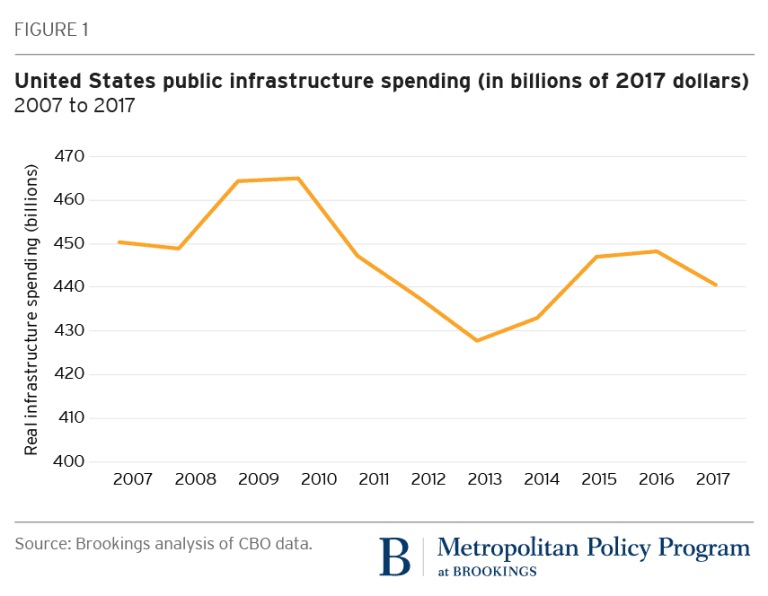
While federal, state, and local governments have spent nominally more on infrastructure in recent years, the rising cost of materials has reduced their real spending power. As a result, real infrastructure spending nationally has fallen over the past decade, from $450.4 billion in 2007 to $440.5 billion in 2017. Although there was a surge in real spending in 2009 and 2010 following ARRA, this bump was short lived, and spending levels have increased only marginally over the last five years—even as many states and localities have improved their fiscal health since the Great Recession.