
Building Bridges to Tomorrow, Not Walls

Date Posted: July 31, 2016
Posted In: Ideas, Workforce,
by Tom Finan, Executive Director, Construction Forum STL
Recently I returned from 10 days on a medical mission to Islandia Peru on the Amazon with my wife and a team of six volunteers from Wash U./BJC.
With a total medical and support team of 80 persons from the U.S. and Colombia we saw 2,600 patients over four days. My main roles were photographer and sterilizing dental instruments.
Jean Paul and family, with part of the St. Louis medical contingent.
While I was traveling I was reading American Future, a book written in 2009 by historian Simon Schama. The book juxtaposes the repetitive themes threading our history, from Jefferson and Hamilton and the conflict that evolved into the development of West Point, through Teddy Roosevelt and and Mark Twain on American imperialism and xenophobia, to modern Bible Belt politics and the Iowa primary in 2008.
He addresses four major themes — the ambivalent attitude of Americans toward war, the rise of American religious tolerance, the idea of America as a melting pot, and the tension between our economy and ecology.
A Trip to “Iceland”
In Islandia, Peru (the name, despite the torrid weather, means “Iceland), is a town of 2,310 people, built entirely on stilts to shield buildings from the Amazon. It is located about an hour by boat from the city of Leticia, Colombia, the demarcation of “Tres Fronteras,” where Brazil, Peru, and Colombia meet on the Amazon.
It was my second trip to the Amazon, but I still had much to learn about the people. As team photographer both times, I had brought along a portable printer which made 4″X6″ photo lab-type prints. I gave away about 300 prints over four days. It was obvious as I gave the prints to mothers, families, and kids that it was the first print of themselves and their kids they had ever held.
But, as I told our U.S. group leader, I myself was blown away by the beauty, dignity, and pride in the eyes of every face as it emerged from my printer.
The people of Islandia are workers and entrepreneurs. I’m an early riser, up by 5:30 a.m. As I strolled the elevated walkways of Islandia I saw cement masons working on a new school, carpenters mitering finish trim without a miter box, bakers, fishermen, and sanitary workers — all working hard, and all proud.
I made special friends with Piero Francis, a boy about 12 years old. He is funny and ambitious. and soon became my “photographic assistant”. Piero displayed an ability to handle both the camera with a great eye, and to manage the crowds of kids and moms that followed me everywhere.
And then there was 16-year-old Jean Paul. He presented at the clinic with a huge wound where his heel bone had pushed through the muscle and skin of the heel. He has spina bifida, and a botched surgery had him walking with a gait that created the issue. His family had been told he was going to die.
My wife has a doctorate in nursing practice and has been a wound care specialist for 35 years. She and her students debrided and dressed the wound, which was healing within a few days. Rumi, our epidemiologist from Wash U. had made a connection with the local three-bed hospital at the health department, where they arranged to have fluids administered.
Jean Paul’s 20-year-old brother Gabriel learned how to dress his brother’s wound. Gabriel and I went down the “street” to a local restaurant to grab a take out lunch for his family. Gabriel wants to go into electronics. Jean Paul, who taught himself to read, is bright and well spoken. He wants to be a doctor. He could do it with the right breaks.
Hopefully Jean Paul will be able to come to St. Louis for treatment to get him walking right.
“Us” Against “Them”
That just might get harder, based on what happens in the coming months. But thus it has ever been in America. Simon Schama notes in the section of his book titled “What is an American” that Thomas Jefferson was concerned about the politics and cultures of immigrants and James Madison was worried about their social background.
The first Naturalization Act of 1790 opened citizenship to “free white persons” (“male” went without saying) over 21 years old. “In 1795, because of anxiety about the influx of politically dubious refugees from European revolutions,” Schama wrote, “the residence requirement for citizenship was raised to five years, and again in 1798 it was raised to again to fourteen. The Alien Act also allowed for the scrutiny of anyone deemed a possible enemy alien and for summary deportation.”
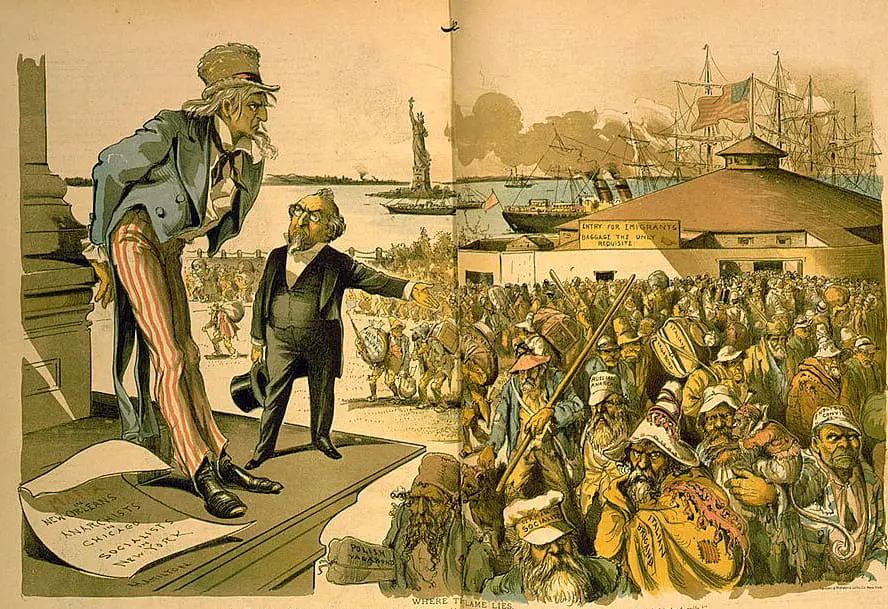 In Schama’s book a political cartoon from 1891, “Where the Blame Lies” best lays out the American ability to shift the focus to “others” for whatever ails us. In the caption, the judge is telling Uncle Sam, “If immigration was properly restricted you would not be troubled with anarchy, socialism, the Mafia, and such kindred evils!”
St. Louis Can Make a Difference
I received an unwelcome surprise while I was in Islandia. I got a forwarded email message via text message (no Internet there) from Mayor Slay’s office, letting me know that he wouldn’t be able to speak Aug. 3. A few days later in Bogotá, Colombia we learned that Betsy Cohen of the St. Louis Mosaic Project would be willing to pinch hit.
Betsy has the facts and figures that show the difference that immigrants are and can make in our St. Louis economy. From many perspectives — workforce, entrepreneurial, investment, and intellectual — we NEED the stimulus that immigrants have been proven to bring. This Wednesday (Aug. 3) you will be able hear that information first hand.
We will also be providing a video update on the first project of the “Gateway Welcome Project“, our effort with a variety of organizations, individuals, and companies to welcome immigrant and refugee kids into a role in the St. Louis region’s future.
“Changing St. Louis demands an inclusive society and a welcoming place,” I recently told a Post-Dispatch reporter who was writing about Gateway Welcome. “It’s not just the right thing to do. It’s the future of what any city that aspires to be anything needs to look like.”
I believed that then, and after my recent trip to Islandia I believe it more than ever. People with the internal beauty, intelligence, and work ethic of those I saw and experienced in Islandia should have the ability to come here, just as my ancestors did.
Immigrants are the future and always have been, no matter what the xenophobes say.